He Who Walks Behind the Rows
Children of the CornHe Who Walks Behind the Rows is the strange corn god at the center of Gatlin’s children’s religion: a deity named in sermons, represented through corn, and obeyed through rules of sacrifice. The story first makes the god legible through the community’s words and objects, then gives its power a physical presence in the corn. At the ending, its intervention overrules the children’s ritual and changes the age at which they believe they must enter the fields to die.
Name and Religious Setting
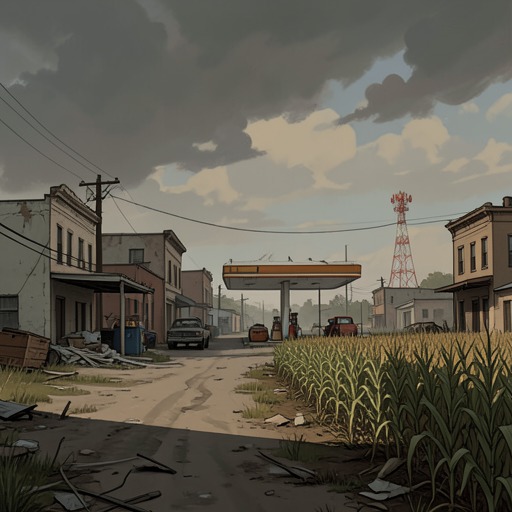
The name appears on a church sermon board announcing “THE POWER AND GRACE OF HE WHO WALKS BEHIND THE ROWS.” Burt reads it as a local name for God, one of the names used in Nebraska, but the sermon’s placement in Gatlin gives the phrase a more particular force: the town’s worship is bound to the corn around it. A nearby radio preacher speaks of atonement and warns against worldly life, while the children’s own religious language increasingly identifies divine authority with the fields.
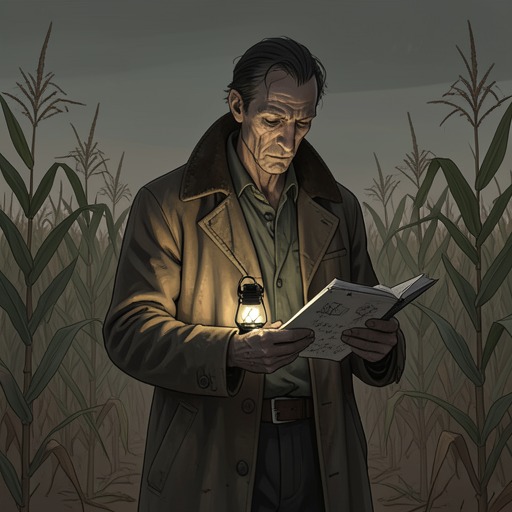
Burt’s account of Gatlin’s past connects this belief to the violent religious upheaval of 1964. He imagines the children and their predecessors isolated among immense stretches of corn, beneath a God transformed into something green, old, and hungry. This is Burt’s interpretation as he tries to understand the town’s history, rather than a complete account of the deity’s origins. The evidence leaves the god’s beginnings unexplained, but makes clear that its worship has shaped the community’s isolation and violence.
Material Signs and Doctrine
The religion leaves tangible signs. Among Vicky’s belongings is a small crucifix made from twisted corn husks, corn silk, and a dwarf corncob. Most kernels have been removed; those left behind form a human figure with outstretched arms and the letters INRI above it. The object joins Christian iconography to the corn itself, turning the crop into both sacred material and an image of sacrifice. Later, after the god intervenes, the girls make many corncob crucifixes in an effort to ward off further evil.
The church’s written material gives the faith a harsh agricultural logic. A book bears the inscription “THUS LET THE INIQUITOUS BE CUT DOWN SO THAT THE GROUND MAY BE FERTILE AGAIN SAITH THE LORD GOD OF HOSTS.” Its words bind punishment to fertility, as though killing could restore the land. This doctrine’s moral authority is presented as part of the children’s religious order; the story does not establish that every written statement is a direct command from the supernatural being.
The God in the Corn
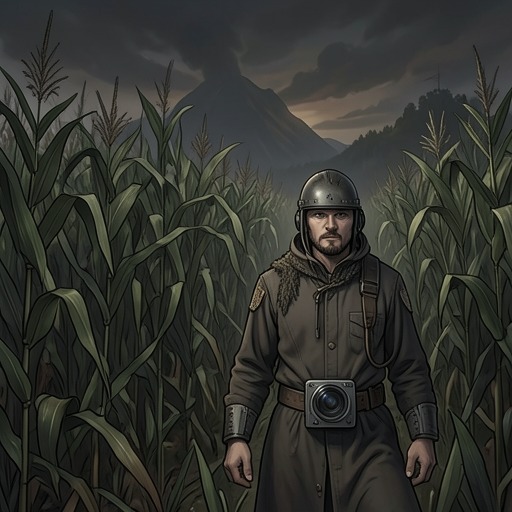
The children treat the corn as a sacred boundary and the clearing within it as a place of killing. At night, Burt hears something much larger than the children approaching through the fields. The rows close behind him, removing his way back, and the corn darkens as a massive presence advances. The narrative identifies the being as He Who Walks Behind the Rows and depicts it as enormous, green, and red-eyed. Its arrival is not merely another ritual performed by the children: the presence comes from the corn itself, and Burt does not survive the encounter.
The distinction between the children’s belief and the story’s supernatural events matters. Much of the deity’s nature reaches the reader through sermons, symbols, and the children’s reports, but the ending gives their faith an external confirmation. The being is not explained by a history or theology; it is made apprehensible through the movement of the corn, the closure of the rows, and its appearance in the clearing.
Authority and the Age of Favor
After Burt and Vicky have been sacrificed, the children gather at midday and look at the bodies and the crucified skeletons in the clearing. Isaac, a nine-year-old who has served as Seer since David was taken by the corn a year earlier, reports a dream in which the Lord appears as a shadow walking behind the rows. In the dream, the deity says that it is displeased with the sacrifice: the clearing was given for killing, but Burt’s sacrifice was a blasphemy, and the god has completed it itself. Isaac’s account presents the intervention as a judgment on the children’s ritual, not as approval of everything they have done.
The message changes the community’s rule. Isaac announces that the Age of Favor—the period before a person must enter the corn—has been lowered from nineteen plantings and harvestings to eighteen. Malachi and Joseph are the only members of the gathered party who have reached eighteen; Malachi accepts the decree, and the corn seems to approve. In the weeks that follow, all those now above the prescribed age walk silently into the clearing to seek the god’s continued favor. The new ruling therefore turns a revelation into immediate collective consequence: devotion requires the older youths to submit to the sacrifice themselves.
Narrative Significance
He Who Walks Behind the Rows governs Gatlin both as a presence in the fields and as the authority invoked to organize the children’s lives. The corn is at once crop, religious emblem, boundary, and instrument of death; the corncob crucifix makes that fusion visible, while the Age of Favor makes it a rule. The deity’s apparent intervention also unsettles the children’s claim to control their own ceremonies. They can lead a hunt and carry out a sacrifice, but Isaac’s revelation recasts the god as a power capable of rejecting their conduct and imposing a stricter demand.
The conclusion keeps the divine force partly beyond explanation. The reader sees a huge figure enter the clearing, then hears its judgment through a child’s dream. That shift—from witnessed presence to interpreted message—makes belief consequential without supplying a neutral account of the being’s motives. Its authority is established through what the children fear, what they obey, and what they do after its command is announced.